info@michgc.com

Riot Glass and Security Glazing for Grand Rapids Schools
Riot glass for Grand Rapids schools is the glazing upgrade that public, charter, and private kindergarten-through-12th-grade facilities in Kent County are specifying as the anchor of their physical security improvement plans, and the buying decision is simpler than the industry jargon around it suggests. Grand Rapids, Kentwood, Wyoming, and Forest Hills school districts, along with the region’s charter and private schools, are currently making decisions about glazing hardening based on safety committee recommendations, facility assessments, and available grant funding.
Riot glass and security glazing from Michigan Glass Coatings gives Grand Rapids schools a plain-English specification path from the front vestibule assessment to the finished installation, with documentation that satisfies both the school board and the grant administrator.
Michigan Glass Coatings serves public school districts, charter schools, and private kindergarten through twelfth-grade facilities throughout Grand Rapids and surrounding areas, including Kentwood, Wyoming, Forest Hills, Caledonia, Lowell, and Rockford.
What Forced-Entry Resistance Actually Means in a School Setting
Forced-entry resistance is a measure of how long a glazing system can delay a determined attacker using hand tools before the attacker can create an opening large enough to reach through or pass through. It is expressed as a time rating under a specific test protocol, meaning the rating is only meaningful when paired with the test standard it was measured against.
In a school security context, the goal of forced-entry resistant glazing is delay, not absolute prevention. No glazing system currently available to schools will stop every possible attack under every possible condition. What forced-entry resistant glazing does is extend the time an attacker needs to breach the entry point, creating a window for lockdown completion, law enforcement response, and the abandonment of the attack.
The surfaces where that delay matters most in a school building are those that connect the public exterior to the occupied interior at points where access control is either absent or can be overcome. The front entry vestibule, the main office adjacent to the entry, and ground-floor classroom windows accessible from outside the building are the three surfaces that drive the most consequential security glazing decisions in Grand Rapids school facilities.
The Standards: What Each Tier Stops
American Society for Testing and Materials Standard F3561 and Underwriters Laboratories 752
Two testing standards are most relevant to school security glazing decisions in Michigan.
The American Society for Testing and Materials standard F3561 specifically covers attack-resistant glazing for school and campus applications. It establishes performance tiers based on the type of attack simulated, the tools used, and the time the glazing must resist. The tiers range from baseline resistance to sustained hand-tool attack, up to resistance against more severe tool categories. For school vestibule and entry glazing in Grand Rapids, specifying a product that has been tested and rated under this standard gives the school board and the grant administrator a documented, third-party-verified performance basis for the specification.
Underwriters Laboratories 752 is a ballistic resistance standard that rates glazing against specific firearm calibers and the number of shots it must withstand. It is the standard referenced when a product is described as bullet-resistant or ballistic-rated. The tiers range from lower-caliber handgun resistance at the entry levels up to high-powered rifle resistance at the upper levels.
Where Riot Glass Fits Versus Ballistic Glass
Riot glass is a forced-entry resistant product. It is engineered to resist sustained hand-tool attack and to delay breach for several minutes under test conditions. It is not a ballistic product unless it is specifically rated under a ballistic standard in addition to a forced-entry standard.
Ballistic glass is a separate product category with a different material construction and a significantly higher cost. It is appropriate for school applications where the primary documented threat is a firearm attack and a ballistic performance requirement drives the specification.
For most Grand Rapids school facilities, evaluating their vestibule and entry glazing, riot glass that meets the American Society for Testing and Materials F3561 standard is the appropriate specification for forced-entry protection. If the school’s security assessment identifies a ballistic threat as a primary concern, Michigan Glass Coatings can advise on products that address both forced-entry and ballistic performance requirements for specific openings.
Security window film installation is the appropriate complementary specification for ground-floor classroom windows and secondary perimeter glass where riot glass is not cost-justified by the threat level, but a meaningful delay layer over existing glass is warranted.
Where to Harden First: Vestibules, Front Offices, and Classroom Doors
The Difference Between Retrofit Glazing Panels and Replacement Glass
Grand Rapids school facilities evaluating security glazing have two installation paths for most applications.
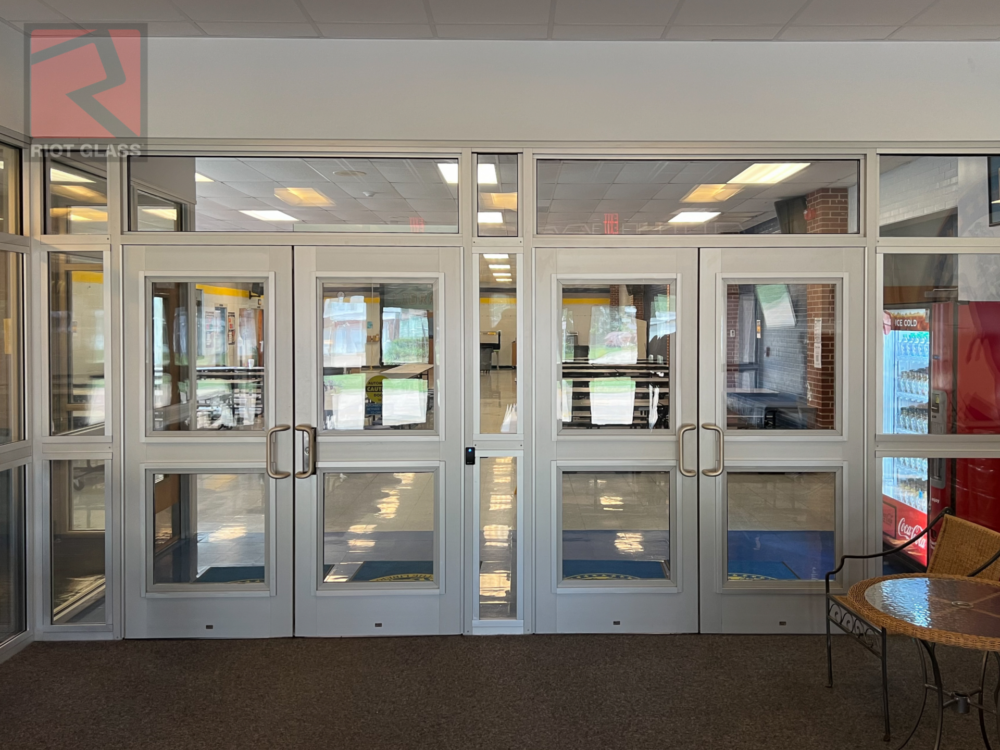
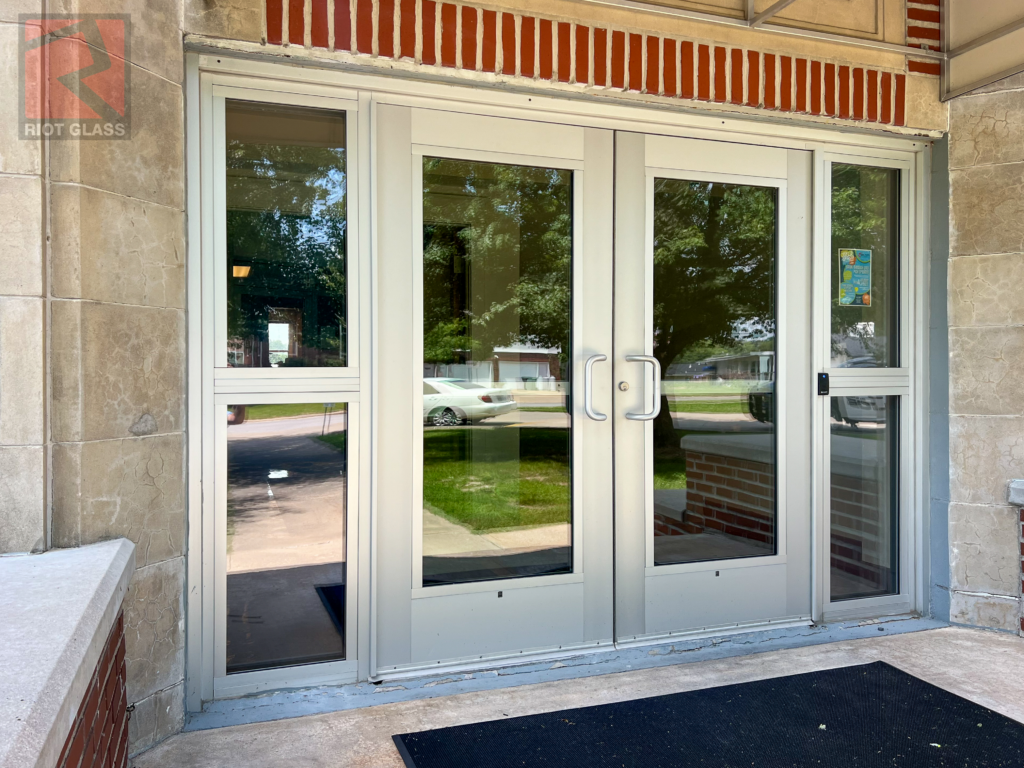
Retrofit glazing panels are non-glass panels installed in front of or within the existing door and window frame system without replacing the underlying glass or the frame. This approach is less disruptive, faster to install, and lower-cost than full replacement. It is the appropriate path for most Grand Rapids school vestibule and entry door upgrades in which the existing frames are structurally sound, and the retrofit panel can be properly anchored within them.
Full glazing replacement removes the existing glass and installs a riot glass panel as the primary glazing in the frame. This approach is appropriate when the existing frames are damaged, when the frame geometry does not accommodate a retrofit panel, or when the performance specification requires a full replacement glazing system for the highest-priority openings.
Priority sequence for most Grand Rapids schools:
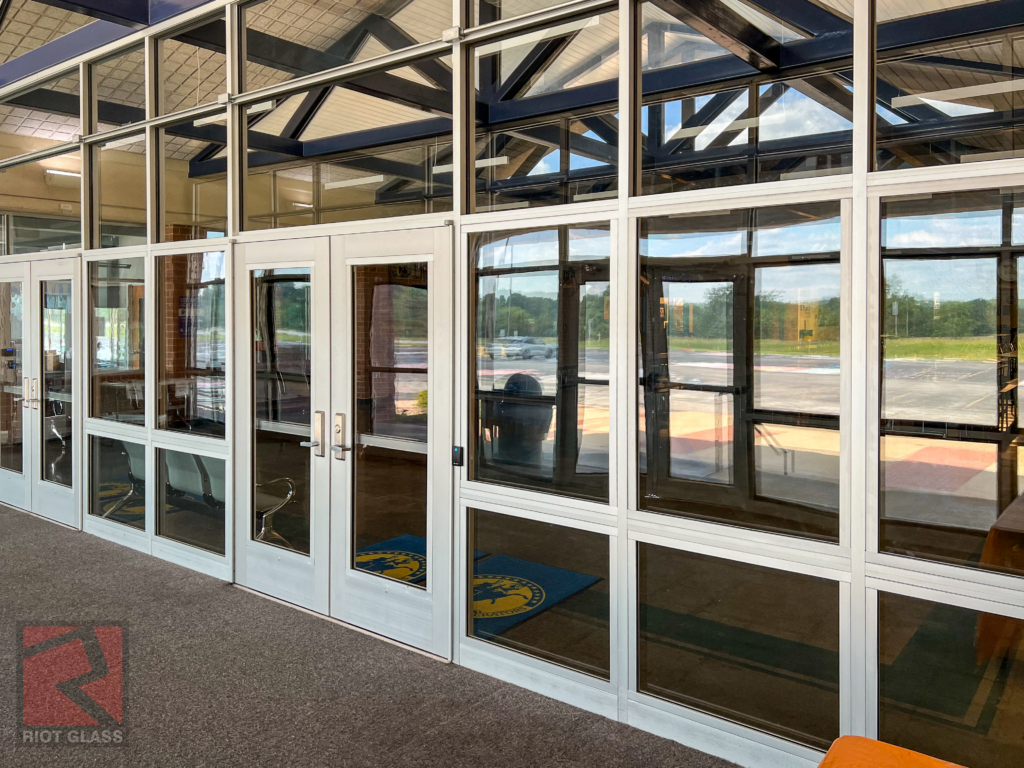
The front entry vestibule is the highest priority in almost every school security glazing plan. This is the single point an attacker must pass through to reach the interior of the occupied building, and hardening this point provides the most consequential forced-entry delay in the building.
The main office adjacent to the vestibule is the second priority. Staff in this area interact with visitors before they are admitted past the vestibule, and glass-fronted offices adjacent to the entry point represent a secondary breach target.
Ground-floor classroom windows accessible from outside the building are the third priority. These surfaces represent an alternative entry point when the main vestibule is secured, and the security film on these windows provides a meaningful delay layer at a cost that is within a school’s security budget.
Funding It: Michigan School Safety Grants and Bond Allocations
Michigan has maintained school safety funding programs through state appropriations, supporting physical security improvements, including glazing upgrades at schools statewide. The Michigan State Police oversees the School Safety Grant Program, which has provided funding to Michigan schools for documented security improvements. Availability, funding amounts, and eligible improvement categories change from year to year based on state appropriations and program guidelines.
At the federal level, the Community Oriented Policing Services Office administers the School Violence Prevention Program, which has funded security glazing projects, including riot glass installations at schools across the country. Grand Rapids area school districts pursuing this funding should engage with the program office and their district’s grant administrator to confirm current eligibility requirements and documentation standards before submitting an application.
Bond allocations are a third funding pathway for Grand Rapids school districts that have passed or are pursuing a facilities bond. Security glazing improvements are an eligible capital expenditure in most Michigan school bond frameworks, and districts with active bond authority can include vestibule hardening in their capital improvement scope.
Michigan Glass Coatings provides product specifications, installation documentation, and project scope descriptions formatted for grant applications and bond expenditure records for every school security glazing project.
Working With a Qualified Installer in the Grand Rapids Area
The quality of a school security glazing installation depends on the installer’s understanding of both the product specification and the operational requirements of an active school campus. Michigan Glass Coatings installs riot glass and security glazing for Grand Rapids-area schools, with crews who understand the access requirements, scheduling sensitivities, and documentation standards required for school facilities projects.
Every school engagement begins with a security glazing assessment that walks the facility with the principal, facilities director, or safety coordinator, identifies the highest-priority glazing surfaces, confirms frame conditions and installation approach for each opening, and produces a written scope that can be presented to the school board, submitted to a grant administrator, or included in a bond expenditure plan.
Installations are scheduled during summer break windows for most Grand Rapids area school projects, with phased scheduling available for projects that need to begin during the school year in unoccupied zones or after-hours windows.
Contact Michigan Glass Coatings today to schedule a security glazing assessment for your Grand Rapids-area school and receive a specification and documentation package that your safety committee, school board, and grant administrator can all use.
Frequently Asked Questions
What forced-entry standard should a Grand Rapids school vestibule meet?
The American Society for Testing and Materials F3561 standard is the most directly applicable forced-entry testing standard for school vestibule glazing. Products rated under this standard have been tested against simulated hand-tool attacks using protocols specifically developed for school and campus applications. Michigan Glass Coatings specifies riot glass products with documented American Society for Testing and Materials F3561 ratings for school vestibule applications and provides the product documentation that safety committees and grant reviewers need to confirm the specification’s performance basis.
Is riot glass the same as bulletproof glass?
No. Riot glass is a forced-entry-resistant product designed to delay a hand-tool breach. Bulletproof or bullet-resistant glass is a ballistic-rated product designed to resist firearm projectiles at specific calibers. These are separate product categories with different material construction, different testing standards, and different cost levels. Some products carry ratings under both forced-entry and ballistic standards, but the two terms describe different performance characteristics and should not be used interchangeably. For Grand Rapids schools where the security assessment identifies a ballistic threat, Michigan Glass Coatings can advise on products that address both requirements for specific openings.
Can existing school doors be retrofitted with riot glass without full replacement?
Yes, in most cases. Retrofit glazing panels are installed within or in front of the existing door frame without replacing the door or the frame, provided the existing frame is structurally sound, and the geometry accommodates the panel. Michigan Glass Coatings evaluates the condition of the door and frame during the security assessment and confirms the suitability of each opening for a retrofit before finalizing the installation scope. Full replacement is recommended only when the existing frame cannot support a properly anchored retrofit panel.
How much does it cost to harden a single school vestibule with riot glass?
The cost to harden a school vestibule with riot glass depends on the number of glazed openings, the size of each panel, whether a retrofit or full replacement installation is appropriate, and the specified performance tier of the product. Michigan Glass Coatings provides itemized written quotes based on the security assessment, so that school districts and charter school operators can evaluate the scope and make informed decisions about prioritization and phasing within their available security budget.
Which Michigan school safety grants can fund security glazing?
The Michigan State Police School Safety Grant Program and the federal Community Oriented Policing Services Office School Violence Prevention Program are the two primary grant programs that have funded security glazing improvements at Michigan schools. Eligibility, funding amounts, and application requirements change from cycle to cycle. Michigan Glass Coatings provides the product specifications, installation documentation, and project scope descriptions that these programs typically require for application submissions. Grand Rapids-area school districts should engage directly with the Michigan State Police and the Community Oriented Policing Services Office to confirm the current availability of programs and requirements before submitting applications.