info@michgc.com

Best Window Film for Sliding Glass Doors
The best window film for a sliding glass door depends on your specific priority, but most people end up with the wrong choice not because they picked the wrong product, but because they made one of a few predictable mistakes along the way. Choosing film for a sliding door isn’t the same as choosing film for a regular window, and that’s where many disappointing results start.
Sliding doors are usually the largest single piece of glass in a home or storefront, sit at ground level, and see more daily use and impact exposure than a typical window. That combination changes what actually matters when selecting film. This guide first walks through the mistakes worth avoiding, then covers the best film options once you know what you’re actually solving for.
Key Takeaways
- Most disappointing sliding door choices stem from a handful of avoidable mistakes, not a lack of good product options.
- Sliding doors pose greater risk than standard windows due to their size, ground-level placement, and greater exposure to impact.
- Darkness and safety performance are two separate specifications, and assuming one implies the other is one of the most common selection mistakes.
- DIY static cling film works for basic privacy or light heat reduction, but it has real limitations for safety-focused applications.
- The right film depends on your door’s actual problem: safety, heat, privacy, or fading, not just what looks good in a showroom.
The Short Answer
There’s no single best film for every sliding glass door, but most people end up with the wrong one by making an avoidable mistake during the selection process, not because the right option didn’t exist. Once you avoid those mistakes, the best choice usually comes down to matching a specific film category (safety, solar control, privacy, or UV protection) to your door’s actual problem.
Why Sliding Glass Doors Need Different Consideration Than Other Windows
Sliding glass doors typically have the largest, most exposed glass panels in a home or business, sitting at ground level and facing high-traffic areas like patios, pools, or storefronts. That combination of size, placement, and exposure means a sliding door faces a wider range of real risks than a standard window, from accidental impact and forced entry to intense heat and UV exposure. Film chosen without accounting for that combination is where problems usually start.
Common Mistakes People Make Choosing Film for Sliding Doors
Assuming Any Tint Works the Same on a Sliding Door
Many people shop for sliding door film the same way they’d shop for a bedroom window, assuming any reasonably good film will do the job. Sliding doors have different demands: more exposure, more foot traffic, and more impact risk, all of which make that assumption risky, particularly when safety is actually the priority.
Prioritizing Darkness Over Safety Rating
Darkness and safety performance are two completely different specifications. A dark, inexpensive film can look like it provides serious protection while offering minimal shatter resistance. In contrast, a lighter, properly rated safety film can outperform it significantly without darkening the glass much. Choosing based on how dark a sample looks, rather than its actual safety rating, is one of the most common and costly mistakes.
Ignoring the Track and Frame When Measuring
Sliding doors have moving parts and a track system that standard windows don’t. Measuring only the visible glass, without accounting for how the panel moves or where the film needs to end near the frame and track, results in film that interferes with the door’s operation or peels prematurely at the edges due to repeated friction.
Underestimating DIY Film’s Real Limitations
DIY static cling film is inexpensive and easy to apply, which makes it tempting for a large sliding door where professional installation costs more. The limitation isn’t the ease of application; it’s performance. Static cling film generally can’t deliver meaningful shatter resistance, which matters more on a sliding door than almost anywhere else in a home.
Best Film Options Once You Avoid Those Mistakes
Safety and Security Film
If safety is the priority, security window film is the strongest option for a sliding door. Sliding doors are a common point of both accidental injury, especially with kids and pets around large glass panels, and forced entry, since they’re often easier to target than a locked door. 3M publishes safety film performance data referencing recognized safety glazing standards, which is worth reviewing directly if impact resistance is your main concern.
Solar Control Film
Sliding doors facing south or west often let in significant afternoon heat and glare, especially since any overhang usually uncovers them. Solar control film reduces heat gain and glare without requiring curtains or blinds to stay closed, keeping the door usable and open to the view.
One-Way Privacy Film
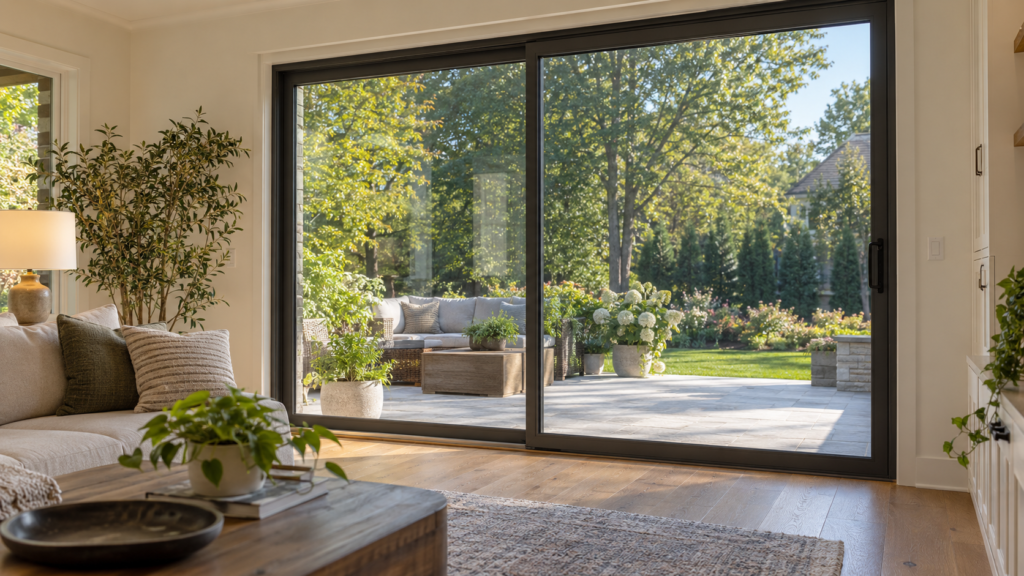
Sliding doors facing a neighbor’s yard, a shared pool area, or a street often create a privacy tradeoff that curtains solve by blocking the view entirely. One-way film addresses this differently, maintaining a clear view from the inside while limiting visibility from outside, particularly effective during daylight hours.
UV Protection Film
Flooring, furniture, and rugs near sliding doors take the brunt of UV exposure over time, since the glass area is large and usually unobstructed for most of the day. UV protection film reduces the risk of fading without changing how the door looks or how much natural light comes through.
Comparison Table
| Film Type | Primary Benefit | Key Limitation | Ideal Scenario |
|---|---|---|---|
| Safety and security film | Shatter resistance, forced entry resistance | No heat, glare, or UV benefit | Ground-floor doors, homes with kids or pets |
| Solar control film | Reduced heat gain and glare | No impact safety, no full privacy | South- or west-facing doors |
| One-way privacy film | Daytime privacy without blocking the view | No UV protection, no impact safety | Doors facing shared or public spaces |
| UV protection film | Reduced fading of floors and furniture | No impact safety, no full privacy | Doors with heavy, unobstructed sun exposure |
DIY vs. Professional Installation for Sliding Doors Specifically
DIY film kits cost less upfront and work well for basic privacy or light heat reduction on a sliding door, especially in a lower-stakes application. DIY consistently falls short on safety and security, since these products aren’t built to the shatter-resistance standard of dedicated security film. A sliding door is exactly the application where that gap matters most, given the size of the glass, how often the door is used, and the potential impact.
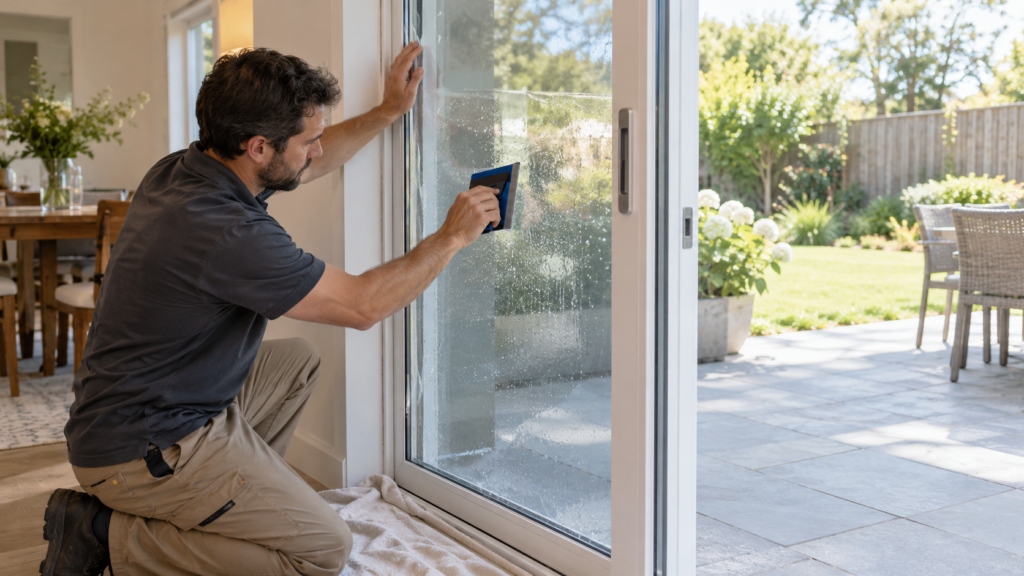
Professional installation also matters more for sliding doors because of the track-and-frame considerations mentioned earlier. Professional measurement and installation account for the door’s moving parts in a way that a self-applied DIY kit often doesn’t, reducing the risk of film interfering with the door’s operation or failing prematurely at the edges.
How to Choose Based on Your Door’s Actual Problem
- Identify the specific problem first. Decide whether safety, heat, privacy, or fading is the priority before looking at specific products.
- Check the safety rating if security is a concern. Don’t rely on how dark a sample looks; ask for documented performance data instead.
- Confirm the film accounts for your door’s track and frame. This matters for sliding doors and is easy to overlook when measuring.
- Decide between DIY and professional installation honestly. DIY is reasonable for privacy or light heat reduction; professional installation is worth it for safety-focused applications.
- Ask about warranty coverage. Warranties can differ significantly between DIY products and professionally installed film, which matters more on a high-use door like a slider.
Conclusion
The best window film for a sliding glass door isn’t really about finding the single best product. It’s about avoiding the handful of predictable mistakes that lead people to the wrong choice in the first place: treating it like a regular window, prioritizing darkness over safety, mismeasuring around the track, or underestimating the limits of DIY. Once those are out of the way, matching the right film category to your door’s actual problem is straightforward.
Frequently Asked Questions
Is DIY film ever a good choice for a sliding glass door?
Yes, for basic privacy or light heat reduction in a lower-stakes application. It’s not the right choice when safety or security is the priority, since it doesn’t provide meaningful shatter resistance.
Why does darkness matter less than I’d expect when choosing safety film?
Darkness affects visible light and glare, not shatter resistance. Safety performance depends on specific film construction and rating, which can be present in lighter films and absent in darker films.
Does professional installation really matter more for sliding doors than regular windows?
Yes, largely because sliding doors have a track and frame, which standard windows don’t. Professional installation accounts for this in ways that are easy to miss with a self-applied DIY kit.
Can one film handle both heat reduction and safety at once?
Some films offer overlapping benefits, but no single film fully covers both priorities at the level a dedicated product would. Decide which matters most before choosing.
How much more does professional installation cost compared to DIY?
DIY is less expensive upfront, but professional-grade film, especially security film, costs more due to material quality and installation expertise, which reflects a real performance difference.
Does one-way privacy film reduce natural light the way blinds do?
No, that’s one of its main advantages. One-way film is designed to keep the room bright and maintain a clear inside view, unlike closed blinds or heavily tinted film, which block or significantly reduce light.
How much of a deterrent is security film against someone actually breaking in?
It significantly increases the time and effort required to get through the glass, since the film holds shattered pieces together instead of letting them fall away. It’s best understood as a strong deterrent and delay, not a guarantee that entry is impossible.
How do I know if my sliding door’s film choice properly accounted for the track?
A professional installer should measure with the door’s movement and track clearance in mind, not just the visible glass area. If you’re doing it yourself, check that the film doesn’t interfere with the door sliding freely before finalizing the installation.
Ready to Choose the Right Film for Your Sliding Door?
Whether it’s a home patio door or a commercial storefront slider, avoiding the common mistakes is the first step to getting a result you’re actually happy with.
Contact us to talk through your door’s specific priorities (safety, heat, privacy, or UV protection) before deciding.