info@michgc.com


Window Film That You Can See Out But Not In
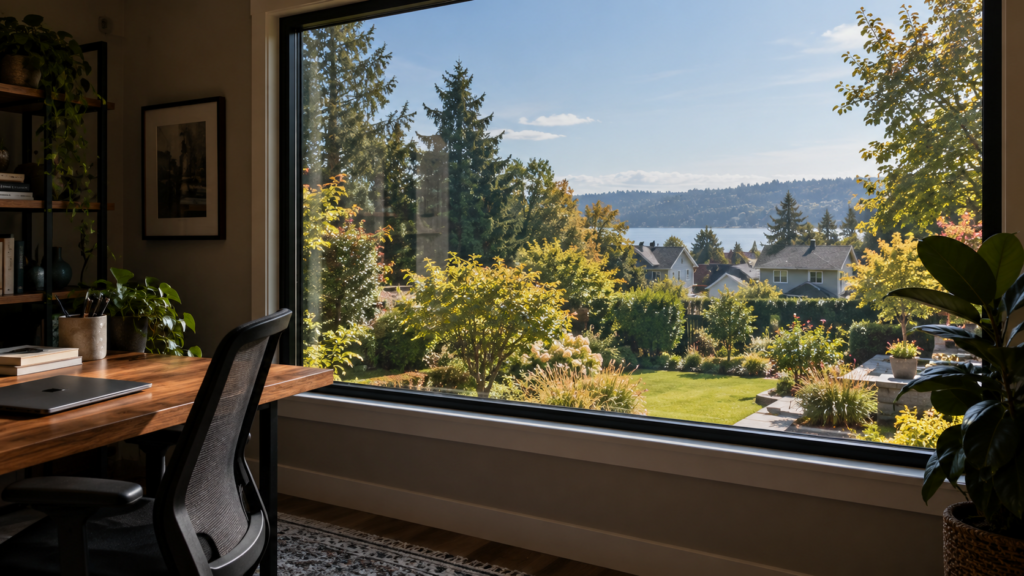
Yes, window film that lets you see out but not in exists and genuinely works, but only under specific lighting conditions. It’s built around a light differential effect: it relies on the outside being brighter than the inside, which holds during most daylight hours but reverses once the sun goes down and the lights are on inside.
That flip is the part that trips people up, and it’s worth understanding before you buy. This film performs exactly as advertised during the day. At night, the same physics that worked in your favor now works against you. This guide covers how the effect actually happens, what changes after dark, and how to plan around it.
Key Takeaways
- This type of window film relies on a light differential effect: it only blocks visibility from the side that’s darker than the other.
- During the day, with more light outside than inside, the film provides real one-way privacy.
- At night, once interior lights are on and it’s dark outside, that differential reverses, and the film’s privacy effect diminishes significantly.
- This mechanism differs from frosted film, which diffuses light rather than relying on a light imbalance between the sides.
- The best use cases are daytime-facing rooms and businesses; rooms used mainly at night need an additional layer of privacy, such as blinds or curtains.
The Short Answer
Window film that lets you see out but not in works by using a reflective coating that blocks visibility only from the brighter side of the glass, typically the outside during the day. Once interior lighting exceeds exterior lighting, usually after dark, that effect reverses, and the privacy benefit weakens considerably. It’s a real, functional product, but one with a specific lighting-dependent limitation worth planning around.
How This Type of Film Actually Works
The Light Differential Principle
This film uses a reflective, metallic-style coating that behaves like a partial mirror. On the brighter side of the glass, the reflection dominates what a viewer sees, making it difficult to see through to the darker side. On the dimmer side, there’s enough contrast to see through the film clearly to the brighter side beyond it. The effect depends on that brightness gap, not on any fixed property of the film itself.
Reflective Coating vs. Frosted Diffusion
This mechanism differs fundamentally from frosted or decorative film, which scatters light in all directions regardless of which side is brighter. Frosted film provides consistent privacy in both directions because it blurs the image itself, not because of a lighting imbalance. One-way reflective film provides no diffusion. Its privacy effect arises entirely from the light differential, which is exactly why it behaves so differently depending on the time of day.
The Catch: What Happens at Night
During the day, sunlight is almost always brighter than typical indoor lighting, so the reflective effect works in the person’s favor. At night, that relationship reverses. A well-lit room viewed from a dark exterior loses most of the one-way effect, since the brighter side has shifted to the inside of the glass. Someone standing outside at night, looking at a lit window with this film, can often see in more clearly than the daytime effect would suggest.
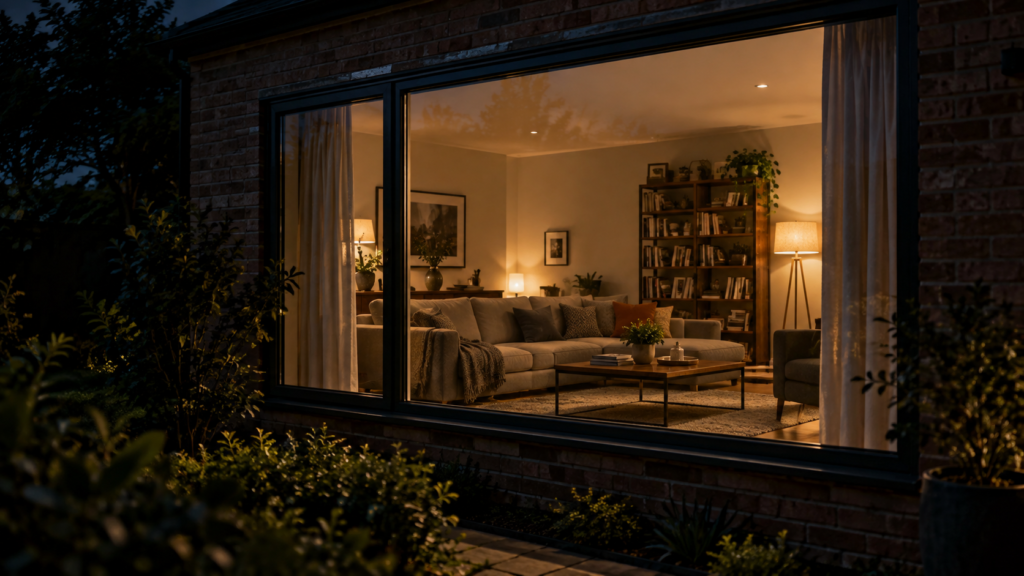
This isn’t a flaw or a defect. It’s how the film’s underlying physics works, and reputable manufacturers in this space address it directly in their own lighting guidance. Anyone buying this film specifically for privacy in a room used at night needs to plan for that limitation from the start, typically by adding blinds or curtains for evening hours.
Where This Film Works Best
- Daytime-facing home offices or living spaces where privacy matters during work or daytime hours
- Retail storefronts or business windows needing daytime privacy or reduced visibility into back-office areas during business hours
- Street-facing rooms used primarily during the day, where nighttime privacy isn’t the main concern
- Any application where the daytime reflective look is itself a desired aesthetic
Where It Doesn’t Work As Well
- Bedrooms or other rooms used primarily at night, where the lighting differential works against the desired privacy
- Any space needing consistent, around-the-clock privacy without an additional covering
- Rooms with unusually bright interior lighting relative to a dim exterior, even during the day, such as heavily lit indoor spaces facing a shaded or covered exterior
Choosing the Right Product
DIY versions of this film, commonly found through general retailers, are inexpensive and simple to apply, making them reasonable for a lower-stakes application or a temporary solution. Professional-grade film generally offers a stronger, more consistent reflective effect and better durability over time, which matters more for a permanent installation on a frequently used window or storefront. Madico, a manufacturer of decorative and reflective window film, engineers its reflective coatings specifically to maximize the light-differential effect during daylight hours. That performance factor separates a well-made product from a basic DIY version.
One-Way Film vs. Other Privacy Options
| Option | Daytime Privacy | Nighttime Privacy | Light Transmission |
|---|---|---|---|
| One-way reflective film | High | Low without added coverings | Moderate to high |
| Frosted film | High, consistent | Moderate, some visibility increase possible | Moderate to high |
| Blinds or curtains | High when closed | High when closed | Fully adjustable |
Conclusion
Window film that lets you see out but not in is a real product that does exactly what it claims, during the day. The nighttime reversal isn’t a marketing gap or a product flaw. It’s simply how the light-differential mechanism works, and it’s worth planning for rather than being surprised by after installation. For daytime-focused privacy needs, this film is a strong option. For round-the-clock privacy, pair it with blinds or curtains for evening hours to get the full picture this film alone can’t provide.
Frequently Asked Questions
Can people see into my house at night if I have this film installed?
Some visibility increases at night when interior lights are on and it’s dark outside, since the lighting differential the film depends on reverses. Closing blinds or curtains in the evening addresses this directly.
Is this the same thing as frosted or privacy film?
No. Frosted film diffuses light and provides consistent privacy regardless of lighting, while this reflective film relies entirely on one side of the glass being brighter than the other.
Does this film work on both home and business windows?
Yes, the mechanism is the same regardless of application, though daytime-focused settings like storefronts or home offices tend to get the most consistent benefit.
Will this film make my room feel dark?
It generally maintains reasonable light transmission, similar to a moderate tint, rather than significantly darkening the room the way blackout film would.
Can I add curtains behind this film for nighttime privacy?
Yes, this is a common and effective approach for rooms used at night, since it adds the coverage the film alone doesn’t provide once the lighting differential reverses.
Is professional installation necessary, or can I use a DIY version?
DIY versions work for lower-stakes or temporary applications, but professional-grade film generally provides a stronger, more durable reflective effect for a permanent installation.
Does this film work the same in every season?
The lighting differential principle remains the same, but shorter daylight hours in winter mean the nighttime limitation applies for a larger portion of the day compared to summer.
Considering This Film for Your Home or Business?
If you’re weighing this type of film for a specific room or storefront, understanding how it performs at different times of day is the key to being satisfied with the result.
Contact us to talk through your space and whether this film alone meets your needs or whether pairing it with another privacy option makes more sense.