info@michgc.com
Bird-Friendly Window Film for Detroit Corporate Campuses
Bird-friendly window film for Detroit corporate campuses is moving from a niche wildlife-conservation upgrade to a documented path toward environmental reporting goals and green-building certification credits for glass-heavy office properties in the metro area. Bloomfield Hills corporate parks, Midtown Detroit mixed-use towers, and the dense commercial corridors along the I-75 and I-696 interchange areas are close enough to the Detroit River flyway and the region’s inland green spaces that bird-strike incidents are a measurable, recurring facility management issue, not an occasional accident.
Michigan Glass Coatings installs feather-friendly film solutions for corporate campuses, institutional buildings, and commercial properties throughout Detroit and surrounding areas, including Bloomfield Hills, Troy, Birmingham, Southfield, and Royal Oak. This guide explains why Detroit-area glass buildings generate bird strikes, how the film works, and how a documented installation supports green building and environmental reporting goals.
Why Bird Strikes Are a Bigger Issue for Detroit Glass-Heavy Buildings Than You Think
Bird strikes against building glass are the second-leading human-related cause of bird mortality in North America, and Detroit-area corporate campuses contribute to that toll in ways that facilities managers rarely quantify. The Detroit region sits within the Atlantic Flyway corridor and in close proximity to the Detroit River International Wildlife Refuge, one of the most significant urban wildlife refuges in the country. Migratory birds moving through the region in spring and fall encounter the reflective glass facades of corporate campuses and mistake the reflected sky and tree canopy for open airspace.
The problem concentrates on specific building types and specific facade conditions. Large curtainwall glass sections that reflect tree canopy or open sky, glass corner conditions where birds attempt to fly through what appears to be an open corridor, atrium glass that creates a see-through effect, and skybridges between buildings are consistently the highest-strike surfaces on Detroit corporate campuses.
The practical facility management consequences include recurring cleanup labor, occasional window damage from high-speed impacts, and, in some cases, the reputational dimension of visible bird mortality near building entrances that employees, visitors, and clients observe. For corporate campuses with active environmental, social, and governance reporting programs, unaddressed bird strike exposure is an increasingly visible gap in the sustainability narrative.
How Bird-Friendly Window Film Works
Bird-friendly window film addresses the fundamental visual problem that causes strikes. Birds cannot perceive glass as a solid surface when it reflects the surrounding environment. The solution is to make the glass surface itself visually detectable to a bird approaching at flight speed from a distance.
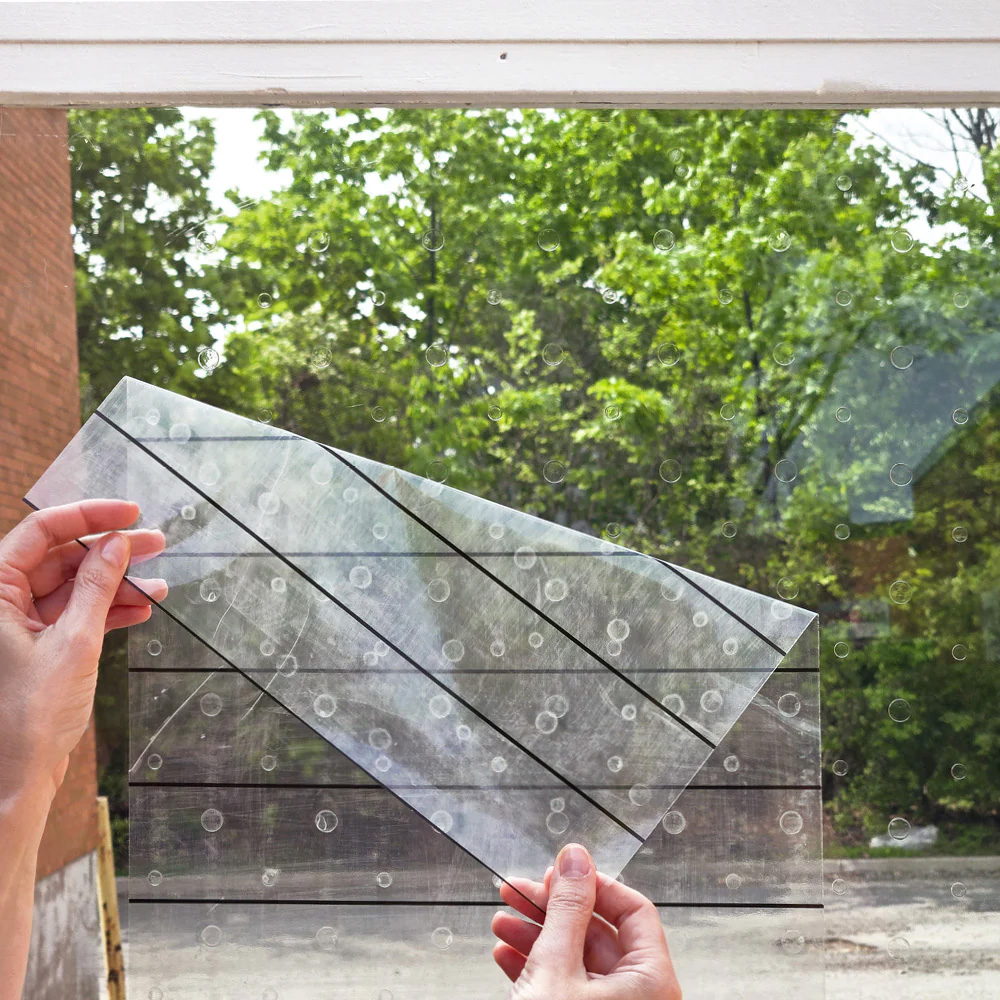
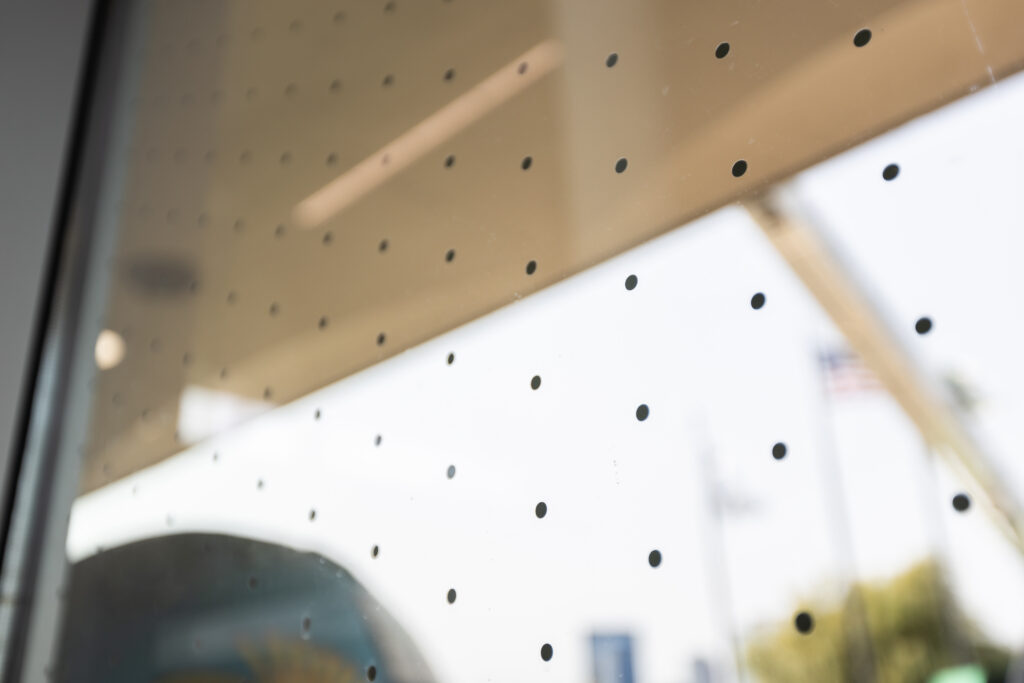
Bird-friendly film applies a pattern of marks, dots, lines, or printed elements to the glass surface at a density and spacing that birds can read as a solid barrier rather than open airspace. The bird detects the pattern at approach distance and adjusts its flight path before reaching the glass. The pattern does not repel birds through any signal or stimulus. It simply makes the glass visible.
American Bird Conservancy Ratings, Two-by-Four Spacing, and What Birds Actually See
The American Bird Conservancy is the primary research organization establishing bird-friendly building standards in North America. Their guidelines recommend that any deterrent pattern applied to glass cover the surface at a spacing of no more than two inches horizontally and four inches vertically to be reliably detectable by birds during normal flight approach. This spacing standard underpins the American Bird Conservancy’s bird-friendly material certification, the recognized third-party rating for products used in green building certification pathways.
Michigan Glass Coatings specifies film products that meet the American Bird Conservancy’s two-by-four spacing standard and provides certification documentation for installations that need to be verified against that standard for reporting or certification purposes.
Leadership in Energy and Environmental Design Pilot Credit 55 and Environmental Reporting
Leadership in Energy and Environmental Design Pilot Credit 55, the bird-collision deterrence credit in the green building rating system, provides a documentation pathway for building owners and project teams seeking formal recognition of bird-friendly glazing measures in a certification submission. The credit requires that at least 90 percent of the exterior glass area visible from outside the building be treated with materials that meet the American Bird Conservancy’s bird-friendly standard or an equivalent third-party rating.
For Detroit corporate campuses pursuing Leadership in Energy and Environmental Design certification for new construction or major renovation projects, bird-friendly window film that meets the American Bird Conservancy standard is a documented path to compliance with Pilot Credit 55. For existing buildings that are not pursuing formal certification but want to include bird strike reduction in their environmental, social, and governance reporting, documented film installation with product specifications and American Bird Conservancy compliance confirmation provides the verifiable evidence that sustainability reports and investor disclosures require.
Michigan Glass Coatings provides full installation documentation for every bird-friendly film project, including product specifications, American Bird Conservancy compliance confirmation, and coverage area records by facade elevation, structured for direct submission to certification reviewers or inclusion in environmental reporting packages.
Retrofit vs. New Construction: Choosing the Right Product
Bird-friendly film is available as both a retrofit product applied to existing glass and as a component specified during new construction or major glazing replacement projects.
Retrofit film is applied to the exterior surface of existing glass without replacing the glass or modifying the frame. It is the appropriate path for Detroit corporate campuses where bird strike mitigation is being addressed as part of a sustainability initiative or in response to documented strike activity on an existing building. Retrofit installation typically has a shorter lead time and a lower cost per square foot than glazing replacement. It can be phased across building elevations in a sequence that prioritizes the highest-strike facades.
New construction specification incorporates bird-friendly film or factory-applied bird-friendly coatings into the glazing specification during design and construction. For Detroit-area corporate campus projects in design development or under construction, specifying bird-friendly glazing at the design stage is more cost-effective than retrofitting after occupancy. It supports documentation for Leadership in Energy and Environmental Design Pilot Credit 55 from the earliest stages of the certification process.
Visual Impact From Inside the Building
The most consistent concern among Detroit corporate facilities directors and sustainability officers evaluating bird-friendly film is how the pattern affects employees’ experience inside the building. The answer depends on the specific product selected, but current-generation bird-friendly film products are designed to balance deterrence effectiveness with minimal visual impact on the interior.
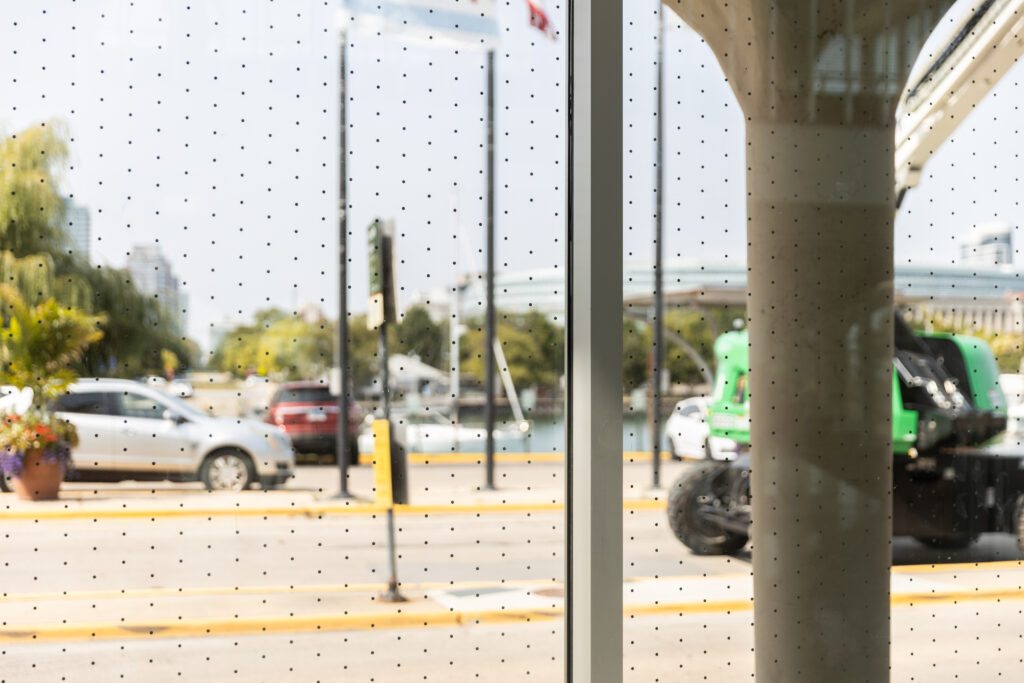
Dot-matrix patterns at the American Bird Conservancy recommended density are visible from inside the building as a subtle texture across the glass surface. At normal workstation viewing distances of six feet or more, the pattern reads as a surface characteristic of the glass rather than an obstruction to the view. Conference rooms, executive offices, and common areas with bird-friendly film on the exterior glass retain workable views with the pattern visible but not dominant.
For applications where interior visual impact is a primary concern alongside deterrence effectiveness, lighter-contrast and lower-opacity pattern options are available to reduce the pattern’s visibility from inside while maintaining the exterior pattern density required for bird detection. Michigan Glass Coatings provides sample panels for interior view assessment on every Detroit corporate campus project before any film is committed to the facade.
What a Detroit-Area Bird-Friendly Film Project Looks Like
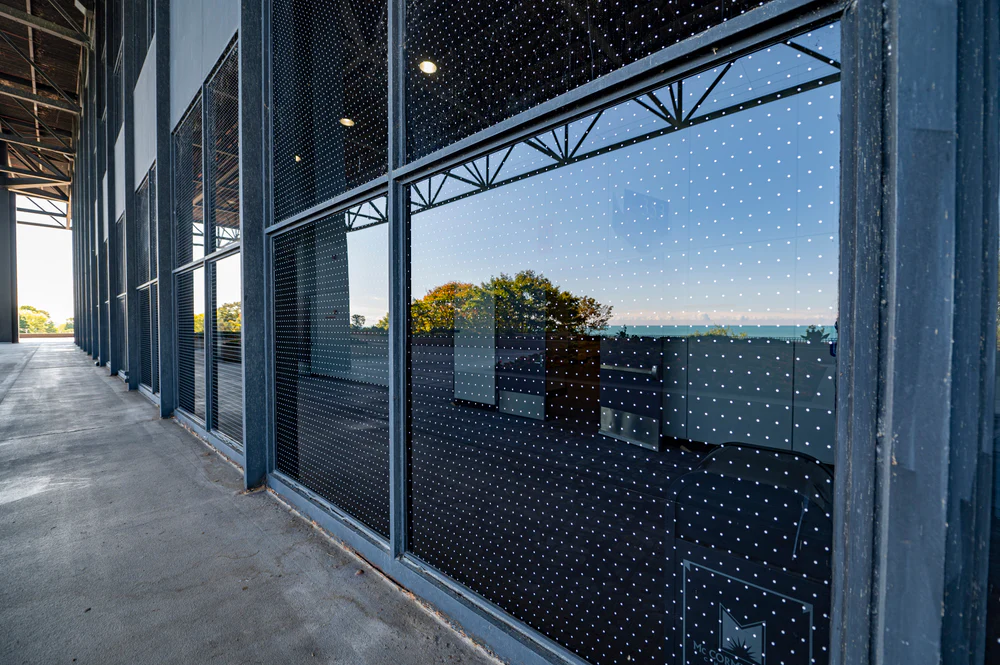
Every Michigan Glass Coatings bird-friendly film project begins with a facade assessment that identifies the highest-strike surfaces on the property, documents existing glass type and condition, confirms compatibility between the proposed film and the existing glazing system, and produces a written scope covering coverage area, product specification, and installation phasing.
For Detroit corporate campuses where bird-strike activity is already documented, the assessment phase can incorporate strike-incident data to prioritize the installation sequence by facade elevation. For campuses beginning proactively as part of a sustainability initiative, the assessment maps the building’s glass orientation and reflectivity conditions to identify the most likely strike concentrations before incidents are recorded.
Installation on standard curtainwall glass proceeds without construction barriers or tenant disruption. Most exterior-surface film applications for Detroit corporate campus buildings are completed by crews working from boom lifts or swing stages outside the building, with no interior access required for the film installation itself. Interior access points for power and communication connections for any associated sensor or monitoring systems are coordinated with facilities management before the project begins.
Contact Michigan Glass Coatings today to schedule a Detroit-area campus assessment and receive a bird-friendly film specification and certification documentation package tailored to your building’s glass profile, sustainability reporting requirements, and installation timeline.
Frequently Asked Questions
Does bird-friendly window film qualify for Leadership in Energy and Environmental Design Pilot Credit 55?
Bird-friendly window film that meets the American Bird Conservancy’s bird-friendly material standard qualifies as a treatment for Leadership in Energy and Environmental Design Pilot Credit 55 when applied at the required coverage level of at least 90 percent of exterior glass visible from outside the building. The credit requires documentation of product compliance with the American Bird Conservancy standard or an equivalent third-party rating. Michigan Glass Coatings provides product specifications and American Bird Conservancy compliance documentation for every installation that is structured for direct submission to a Leadership in Energy and Environmental Design certification reviewer. Building project teams should confirm the current Pilot Credit 55 requirements with their certification consultant before finalizing the project scope.
Will employees inside the building be able to see the bird-deterrent pattern?
Yes. The pattern is visible from inside the building as a subtle texture across the glass surface. At normal workstation and conference room viewing distances, the pattern reads as a surface characteristic rather than an obstruction and does not significantly affect the usability of the view. Michigan Glass Coatings provides sample panels for interior view evaluation on every Detroit corporate campus project before any film is installed, so that facilities directors, design leads, and building ownership can assess the visual result in the actual building environment under actual lighting and viewing conditions before committing.
Can bird-friendly film be installed on existing windows without replacing glass?
Yes. Bird-friendly film is a retrofit product applied to the exterior surface of existing glass without replacing the glass or modifying the frame. It is compatible with the curtainwall and punched-window systems common in Detroit corporate campus buildings. The condition of the glass and any existing exterior coatings are assessed during the site evaluation to confirm compatibility with the proposed film product before installation is scheduled. Most Detroit-area corporate campus retrofit installations proceed without construction barriers or building access disruption during the film application phase.
How long does feather-friendly film last in Michigan winters?
Exterior-rated, bird-friendly film specified for Michigan’s climate is typically rated for 7 to 10 years under normal conditions. Michigan winters create demanding conditions for exterior film through freeze-thaw cycling, ice formation, and the mechanical stress of snow removal on glass surfaces. Film longevity in Michigan’s climate depends on selecting the correct product for exterior exposure, proper installation with sealed edges and an appropriate adhesive for cold-climate performance, and avoiding abrasive cleaning or ice removal methods that damage the film surface. Michigan Glass Coatings specifies exterior-rated products appropriate for Michigan’s climate and provides care guidelines with every installation to support the full rated service life through Michigan winters and summers.