info@michgc.com
Di-Noc Architectural Finishes for Grand Rapids Hotel and Office Renovations
Di-Noc architectural finishes for Grand Rapids hotels and office buildings are filling the refresh-cycle gap that most properties fall into between major capital renovation windows. Downtown Grand Rapids hotels along Monroe Center and the Arena District, extended-stay properties in the Cascade and Kentwood corridors, and Class B office buildings throughout the metro are all managing the same challenge: the last major renovation is starting to show its age on the surfaces that guests and tenants interact with most, but the next planned capital improvement cycle is still two to four years away.
Di-Noc architectural resurfacing from Michigan Glass Coatings lets Grand Rapids hotels and offices close that gap by refreshing elevator cabs, guest-room casegoods, lobby reception desks, and common-area surfaces in days rather than weeks, without taking the property offline or incurring the capital outlay of a full replacement.
Michigan Glass Coatings serves hotels, extended-stay properties, office buildings, and commercial facilities throughout Grand Rapids and surrounding areas, including Kentwood, Wyoming, Walker, Cascade, and East Grand Rapids.
The Refresh-Cycle Gap That Di-Noc Fills
Every Grand Rapids hotel and office building operates on a capital improvement cycle. Major renovations are scheduled based on brand standards, ownership decisions, and available capital, and these schedules typically span five- to ten-year intervals for significant physical plant improvements.
The problem is that the surfaces guests and tenants interact with most visibly, elevator interiors, guest-room furniture, lobby reception areas, and common corridor elements, show age on a much shorter timeline than the capital cycle allows for. By year three or four after a renovation, elevator cab panels are scratched, guest-room vanity tops and dresser surfaces show wear marks that professional cleaning cannot address, and reception desk fascias have developed the dull, dated look that prospective tenants and hotel guests notice on a walkthrough, even if they cannot articulate exactly what they are seeing.
Di-Noc resurfacing addresses these surfaces between capital cycles at a cost and timeline that does not require a formal capital improvement project. The existing surface stays in place. A commercial-grade architectural film bonds to it and transforms its appearance to a current finish standard. The property looks refreshed without the revenue displacement of a major renovation.
What 3M Di-Noc Architectural Finish Actually Is
3M Di-Noc is a commercial-grade architectural film manufactured and tested for application to existing interior surfaces in commercial and hospitality environments. It is available in hundreds of finish options, including wood grain, stone, metal, leather, textile, and solid-color treatments, at various gloss levels and surface textures. The film bonds to existing substrates, including wood veneer, laminate, metal panels, painted surfaces, and most other smooth interior materials, without requiring the substrate to be removed.
Wood, Stone, Metal, and Leather Looks in a Film
The finish range available through Di-Noc covers the full spectrum of current hospitality and commercial interior design directions. Light natural oak and warm walnut grain finishes are consistent with the biophilic design direction that Grand Rapids hotel brands and corporate campuses are currently specifying. Brushed aluminum and matte black metal finishes work for the clean contemporary aesthetic common in newer Class A office lobbies and downtown hotel common areas. Stone and concrete look serve the industrial-modern design direction that has become standard in the Arena District and West Side mixed-use properties. Leather-look finishes on case goods and reception desk fascias add a tactile quality to surfaces that guests and tenants appreciate without the maintenance requirements of genuine leather in high-contact areas.
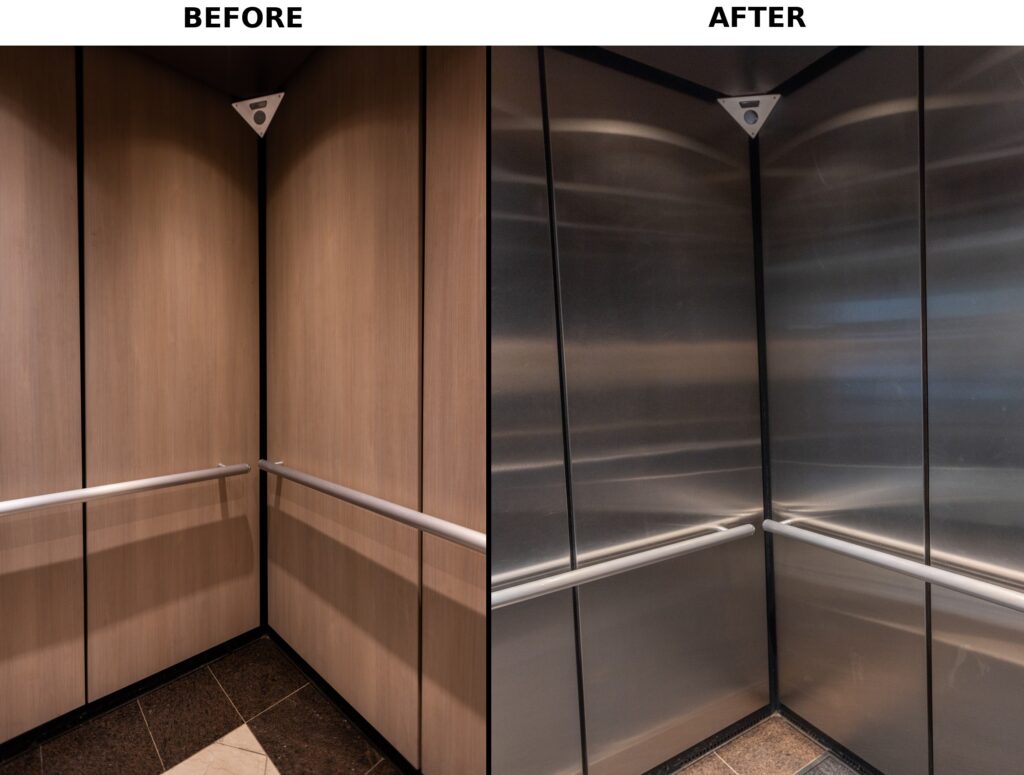
At normal interior viewing distances and under standard commercial lighting conditions, Di-Noc finishes read as the material they reference. A walnut-grain finish on a guest-room dresser reads as a wood-grain furniture surface. A brushed metal finish on an elevator cab panel reads as metal. The distinction between film and genuine material is not visible to the guest or the tenant in normal use.
Highest-Impact Use Cases in Grand Rapids Hotels and Offices
Guest-Room Casegoods and Vanity Tops
Guest-room furniture surfaces are the highest-volume Di-Noc application in Grand Rapids hotels because every room has them, and they age visibly in ways that affect guest perception and online review scores. Dresser tops, nightstand surfaces, desk surfaces, and vanity areas in guest rooms accumulate surface wear, scratches, and finish degradation that housekeeping cannot address. Replacing case goods across a full hotel floor requires a capital outlay and a room-block-out period that most Grand Rapids hotel operators cannot justify outside of a planned renovation cycle.
Di-Noc on existing case-good surfaces addresses visible wear without replacing the furniture. The film bonds to the existing surface, refreshes the finish to a current specification, and extends the service life of the case good by another renovation cycle. The room can be out of service for one day for the resurfacing work and returned to inventory the following morning.
Vanity tops and bathroom surface elements showing wear can be addressed with Di-Noc in applications where the surface is suitable for film bonding. Michigan Glass Coatings evaluates the surface condition during the property assessment and identifies which bathroom surfaces are suitable candidates, as well as the guest-room furniture scope.
Elevator Cabs, Reception Desks, and Common-Area Doors
Elevator cabs are the single highest-impact Di-Noc surface in any Grand Rapids commercial or hospitality property because they interact with every guest or tenant on every floor visit. A single day of resurfacing per cab transforms the elevator interior from a dated or worn surface into a finished architectural space that conveys the property is well-maintained and current.
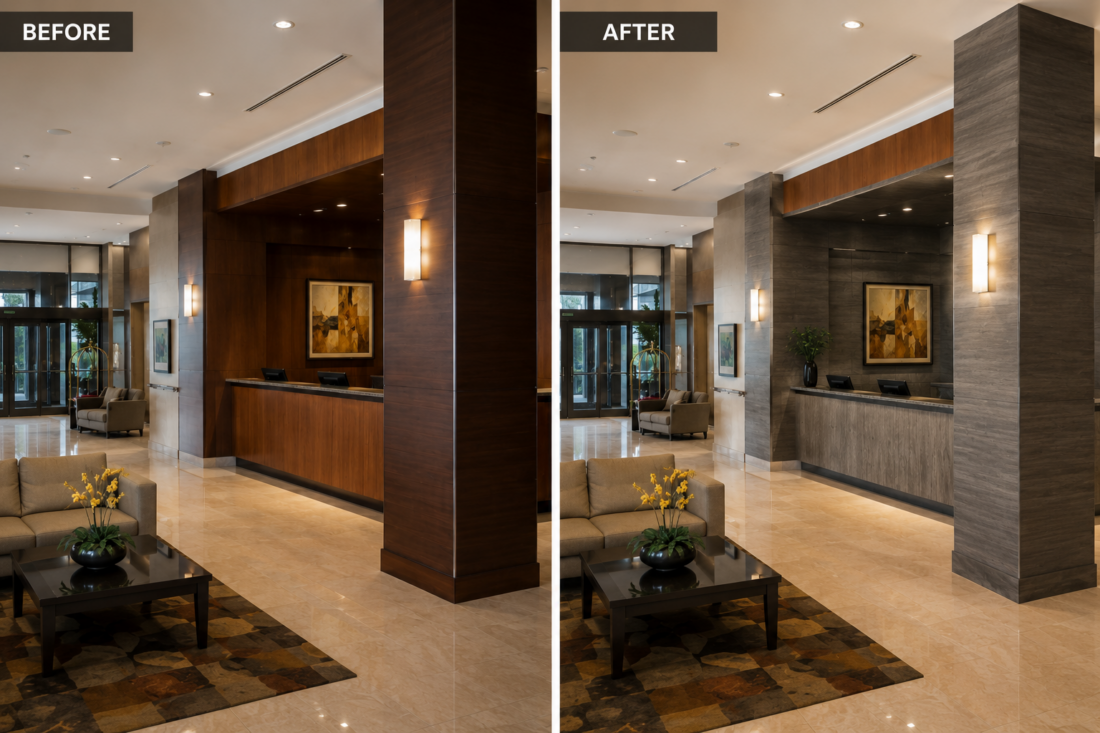
Reception desk fascias and lobby feature walls adjacent to the entry are the second-highest-impact surface category for Grand Rapids hotels and offices. These are the surfaces that set the first impression for arriving guests and prospective tenants during walkthroughs, and updating them with a current finish delivers the visual-quality signal that leasing agents and hotel brand inspectors look for without a full lobby rebuild.
Common-area corridor doors are a lower-cost, high-volume application specifically for hotels. Resurfacing door faces across a full floor refreshes the guest’s visual experience through the corridor at a cost that is accessible within a routine maintenance budget rather than a capital improvement allocation.
Decorative window film for renovations is a natural companion for Grand Rapids hotel and office refresh projects that also include lobby glass partitions, conference room glazing, or guest-facing interior glass.
Cost, Lifespan, and How It Compares to Replacement
The cost advantage of Di-Noc resurfacing over full-surface replacement is consistent and significant across all application categories. For hotel case goods specifically, replacing a full floor of guest-room furniture involves procurement lead time, room blocks for delivery and installation, furniture disposal costs, and a per-room cost that is a multiple of what Di-Noc resurfacing costs for the same surfaces.
Di-Noc in commercial interior applications is rated for seven to twelve years under normal use conditions. For hotel guest rooms and office common areas where the finish cycle aligns with a four- to six-year brand standard review, Di-Noc delivers more than one full brand-cycle service life from a single application, making the cost-per-cycle comparison with replacement even more favorable.
For Grand Rapids office buildings, the 60 to 80 percent cost savings compared to demolition-based renovation that Di-Noc delivers on lobby and elevator surfaces is the number that consistently moves property managers from evaluation to commitment on a resurfacing project.
Keeping a Property Operational During a Di-Noc Refresh
The operational impact of a Di-Noc refresh on a Grand Rapids hotel or office is one of its most practical advantages over traditional renovation. There is no demolition, no construction debris, no noise from power tools, and no dust or chemical odors affecting adjacent occupied spaces.
For hotels, room-level resurfacing is scheduled through the normal out-of-service rotation so that no full floor or room block needs to be taken offline simultaneously. A single room receives its case good resurfacing during a standard out-of-service day and returns to inventory the following morning. Elevator cab resurfacing is scheduled one cab at a time to maintain vertical access throughout the project.
For offices, the lobby, and common areas, resurfacing is scheduled during early-morning or weekend windows to keep the building fully presentable and operational for tenants throughout business hours during the project.
Michigan Glass Coatings coordinates every Grand Rapids commercial and hospitality resurfacing schedule directly with the property manager, general manager, or facilities director to confirm daily access, sequencing, and any special events or high-occupancy periods that affect the installation timeline.
Contact Michigan Glass Coatings today to schedule a property assessment for your Grand Rapids hotel or office and to get a Di-Noc resurfacing scope tailored to your finish priorities, brand standards, and operational calendar.
Frequently Asked Questions
How long does Di-Noc architectural film last in a Grand Rapids hotel guest room?
Commercial-grade Di-Noc film for a hotel guest room application is rated for 7 to 12 years under normal conditions. Guest room case goods receive daily contact from guests and routine cleaning from housekeeping, which places these surfaces in the middle range of the lifespan spectrum. Di-Noc in Grand Rapids hotel applications consistently delivers multiple brand review cycles of service life from a single resurfacing, making it a cost-effective alternative to full case good replacement for properties managing finish quality between major capital cycles. Michigan Glass Coatings provides care guidelines with every hospitality installation that align with standard hotel housekeeping protocols.
Can Di-Noc be installed without taking guest rooms out of service for long?
Yes. A standard guest-room case good resurfacing scope, covering dresser, nightstand, and desk surfaces, is completed within a single out-of-service day, and the room returns to inventory the following morning. Michigan Glass Coatings coordinates the room-level resurfacing schedule with the hotel’s rooms management team so that the work sequences through the normal out-of-service rotation without requiring a block of rooms to be taken offline simultaneously. For Grand Rapids hotels with constrained inventory or during high-occupancy periods, scheduling can be concentrated in low-occupancy windows or extended over a longer calendar to minimize the impact of any single night.
Does Di-Noc resurfacing meet commercial fire-rating requirements?
3M Di-Noc architectural film carries fire performance ratings that meet the requirements for interior finish applications in commercial buildings under standard building codes. Specific fire-rating documentation is available for each Di-Noc product specification and can be provided to property managers, brand compliance reviewers, and building code officials upon request. Michigan Glass Coatings includes fire-rating documentation in the installation package for every Grand Rapids commercial and hospitality project that requires code-compliance documentation.
How does Di-Noc compare in cost to replacing hotel case goods?
Di-Noc resurfacing of existing hotel case goods typically costs 60 to 80 percent less than replacing the same pieces with new furniture when the full replacement cost is calculated, including procurement, freight, installation, and furniture disposal. The cost advantage is most pronounced in properties where the existing case goods are structurally sound, and the finish is the only element that has degraded. For Grand Rapids hotel operators managing finish quality between planned capital cycles, Di-Noc delivers a complete visual refresh at a cost that fits within a routine maintenance or minor capital budget rather than a major renovation allocation.