info@michgc.com

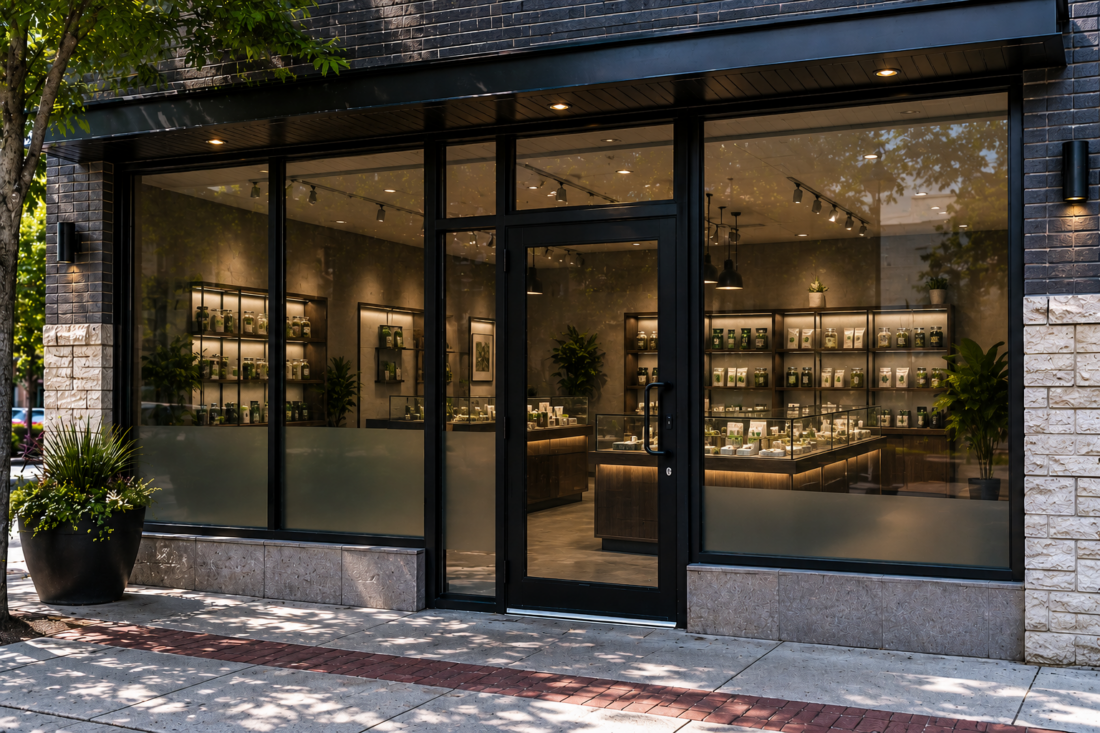
Security Window Film for Grand Rapids Cannabis Dispensaries
Security window film for Grand Rapids cannabis dispensaries is the glazing upgrade that is showing up in Michigan Cannabis Regulatory Agency security plan submissions, dispensary insurance underwriting conversations, and post-incident remediation projects across Kent County and the surrounding market.
Grand Rapids dispensaries in the Fulton Street corridor, the South Division retail district, and the suburban communities of Kentwood, Wyoming, and Walker are operating in a high-value retail environment where the combination of cash handling, controlled-substance inventory, and extended operating hours creates a security profile that standard storefront glass does not address. Security window film installation from Michigan Glass Coatings gives Grand Rapids dispensaries a documented, inspectable, and insurance-supported glazing hardening solution that fits within operating budgets and installs without requiring store closures.
Michigan Glass Coatings serves cannabis dispensaries, high-risk retail operators, and commercial properties throughout Grand Rapids and surrounding areas, including Kentwood, Wyoming, Walker, Grandville, and Rockford.
Why Grand Rapids Dispensaries Need More Than a Standard Storefront
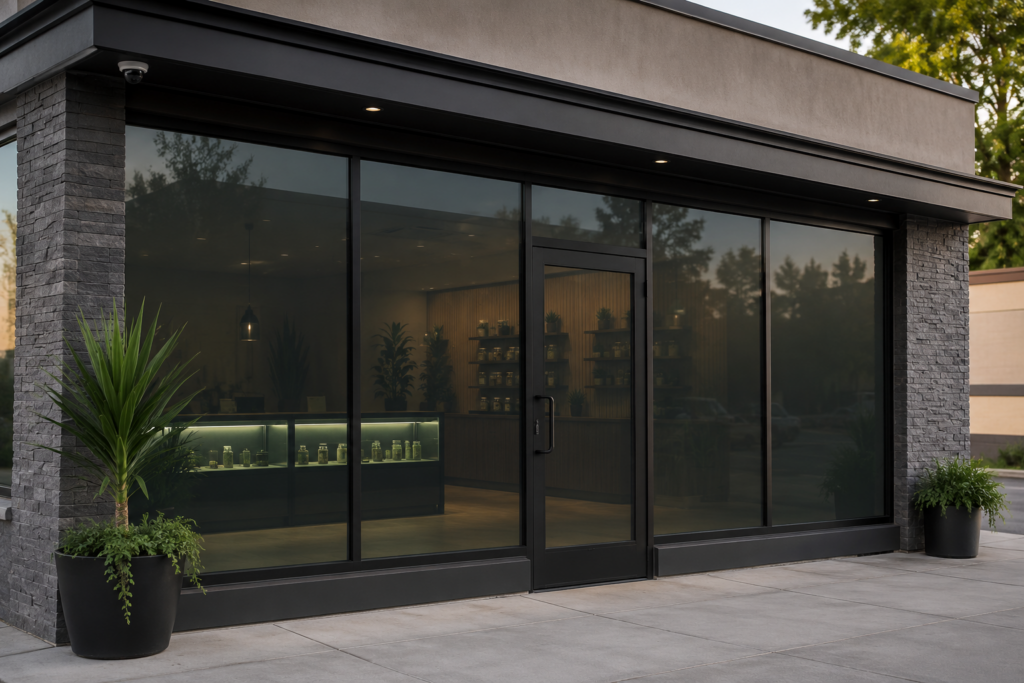
Cannabis dispensaries are consistently among the highest-risk retail categories for smash-and-grab and after-hours forced-entry attacks. The combination of factors is well-documented: concentrated high-value inventory visible through storefront glass, cash on premises, operating hours that extend into the late evening, and, in some locations, the perception of a limited after-hours security presence. Grand Rapids has not been immune to this pattern, and dispensary operators across the metro have seen enough incident documentation from comparable markets to understand that the question is not whether to harden the storefront but which level of hardening is appropriate for their specific location and risk profile.
Standard tempered storefront glass, which is the default glazing in most Grand Rapids retail construction, clears in one or two strikes with a blunt instrument. An attacker who breaks that glass has an unobstructed opening to reach through within seconds. Security window film changes that outcome by holding broken glass fragments together so that the opening does not form on the first strike, requiring sustained effort to create access and consuming the time that the attack’s speed and surprise depend on.
Michigan Cannabis Regulatory Agency Security Rules and Glazing Expectations
The Michigan Cannabis Regulatory Agency requires all licensed dispensaries to maintain a written security plan that addresses the facility’s physical security. The security plan must document measures that protect the facility against unauthorized access, theft, and diversion of controlled substances.
What Inspectors and Insurers Are Actually Looking For
Michigan Cannabis Regulatory Agency inspectors reviewing dispensary security plans are looking for documented, verifiable physical security measures that are proportionate to the risk profile of a cannabis retail operation. The agency does not mandate a specific glazing product by name. Still, the expectation that physical barriers protect controlled-substance inventory and cash-handling areas from unauthorized access creates a clear need for documentation demonstrating that security glazing installation records satisfy this requirement.
Dispensary insurance underwriters in Michigan are a parallel audience for the same documentation. Cannabis retail insurance is a specialized line in which underwriters assess the facility’s physical security posture as a primary underwriting factor. Documented glazing hardening measures, with product specifications and installation records from a qualified contractor, support the underwriting submission and, in some cases, directly affect the terms of coverage offered.
Michigan Glass Coatings provides written installation documentation for every dispensary security glazing project, structured for submission to Michigan Cannabis Regulatory Agency reviewers and insurance underwriters. The documentation includes product specifications, film type and thickness, attachment system details, and coverage area by opening.
Tiers of Protection: Safety Film, Security Film, and Riot Glass
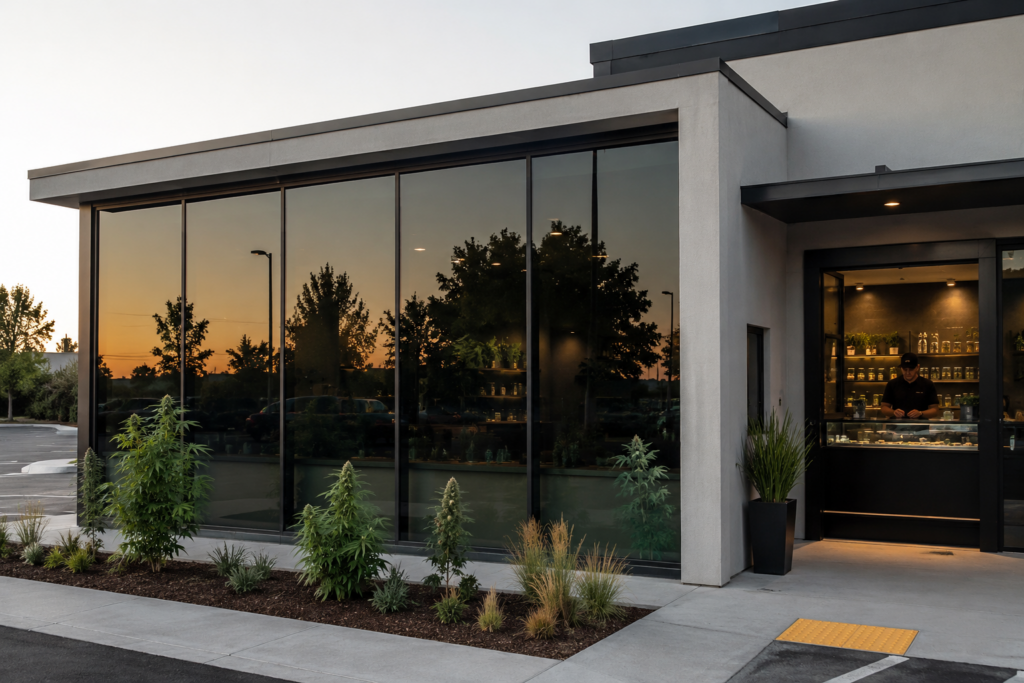
Grand Rapids dispensary operators evaluating glazing security have three product tiers to choose from, and the appropriate specification depends on the threat level of each opening in the facility.
Safety film at four thousandths of an inch is the entry-level specification. It holds broken glass together after impact and provides a modest delay against opportunistic attacks. It is appropriate for secondary and perimeter glass surfaces in a dispensary where the threat is low, and the goal is a baseline fragment-retention layer rather than a meaningful forced-entry delay.
Security film at eight to fourteen thousandths of an inch is the standard specification for dispensary storefront glass. It holds broken glass together more effectively under harder, more sustained impacts and, when combined with a mechanical attachment system, significantly extends the forced-entry delay time. This is the tier that most Grand Rapids dispensary storefronts should specify for primary entry glazing, display window glass, and any glass adjacent to cash-handling or product-display areas.
Riot glass is a structural panel product, not a film. It is the appropriate specification for the highest-threat openings in a dispensary, including primary entry vestibule glass, budtender counter enclosures, and vault room adjacent glazing where the value of the inventory behind the glass justifies the higher per-opening investment. Riot glass for high-risk retail from Michigan Glass Coatings delivers forced-entry resistance that film alone cannot match for these priority openings.
Anchored vs. Daylight Application and Why It Matters
The attachment system is the element that most significantly affects the real-world performance of security film on a Grand Rapids dispensary storefront.
Film applied without an attachment system, sometimes called a daylight application, bonds the film to the glass but does not mechanically connect the glass-and-film assembly to the window frame. Under sustained pressure or repeated heavy impact, the intact glass and film assembly can be pushed out of the frame as a unit, creating the opening the attacker is trying to create.
An anchored application uses structural adhesive, mechanical fasteners, or both to bond the glass-and-film assembly to the window frame. When the glass is struck, and the film holds the fragments together, the frame connection prevents the assembly from being pushed through. The forced-entry delay time of an anchored installation is significantly longer than that of a daylight installation using the same film product.
Michigan Glass Coatings specifies anchored attachment systems as the standard for dispensary storefront applications in Grand Rapids and evaluates the appropriate anchoring method for each frame type during the site assessment.
Insurance Implications and Underwriting Credits
Cannabis dispensary insurance in Michigan is underwritten with particular attention to physical security measures because a dispensary’s product and cash exposure is substantially higher than in most other retail categories. Some Michigan cannabis insurance carriers provide premium credits or more favorable coverage terms for dispensaries with documented glazing hardening measures that meet a minimum performance standard.
The credit and terms improvement is not universal across all carriers and policy types, and the specific benefit depends on the carrier’s underwriting guidelines for the policy being written. What is consistent is that a documented security glazing installation, with product specifications and performance data, gives the dispensary operator a verifiable physical security measure to present to the underwriter, which is better than no documentation and often better than a general security description without specific product evidence.
Michigan Glass Coatings provides installation packages structured for insurance submission for every dispensary security glazing project. Dispensary operators should share this documentation with their insurance broker before and after installation to understand how their specific carrier evaluates security glazing improvements under their current policy.
Commercial window tinting services can also be incorporated alongside security film for Grand Rapids dispensaries where privacy on storefront glass, solar control in public-facing areas, or decorative film on display counter glass is part of the overall facility improvement scope.
Choosing the Right Tier for Your Storefront and Vault Areas
The most effective and cost-efficient security glazing specification for a Grand Rapids dispensary is a tiered approach that matches the product to the threat level of each specific opening rather than applying a single specification uniformly across all glass surfaces.
Storefront entry and display glass facing the street or parking lot should receive eight to fourteen thousandths-of-an-inch security film with an anchored attachment system. This tier delivers meaningful forced-entry delay at a cost that fits within most dispensary security budgets and is the specification most directly supported by Michigan Cannabis Regulatory Agency security plan documentation.
Budtender counters and point-of-sale enclosures where cash handling and immediate product access are highest are the appropriate locations for riot glass. The per-opening cost is higher than that of security film, but these are the surfaces where the financial exposure of a successful breach is greatest.
Secondary and perimeter glass, including windows on non-primary elevations and back-of-house glass, can receive safety or entry-level security film as a baseline fragment retention layer at a lower cost per square foot than the primary entry specification.
Michigan Glass Coatings assesses each opening during the site visit, identifies the appropriate product tier based on the opening’s location, threat exposure, and frame condition, and produces a written scope that documents the specification decision for each surface.
Contact Michigan Glass Coatings today to schedule a security assessment for your Grand Rapids dispensary and get a tiered glazing specification and documentation package that satisfies your security plan requirements and supports your insurance underwriting.
Frequently Asked Questions
Does security window film satisfy Michigan Cannabis Regulatory Agency dispensary security requirements?
Security window film installation, with documented product specifications and attachment system details, supports the physical security documentation required for Michigan Cannabis Regulatory Agency security plan submissions. The agency does not mandate a specific glazing product by name. Still, it expects dispensaries to demonstrate that physical barriers are in place to protect controlled-substance inventory and cash-handling areas. Michigan Glass Coatings provides installation documentation structured for security plan submission, and dispensary operators should work with their licensing attorney or compliance consultant to confirm how glazing documentation fits within their specific security plan structure before submitting.
Will security film actually stop a smash-and-grab on a Grand Rapids dispensary?
Security film with an anchored attachment system will not prevent the glass from breaking on impact, but it holds the broken glass together so that an opening does not form on the first strike. Most smash-and-grab attempts are abandoned within two to three minutes when the glass does not clear as expected. An anchored security film installation at eight to fourteen thousandths of an inch on primary storefront glass extends the breach time beyond the window within which most opportunistic attacks operate, meaning the majority of real-world smash-and-grab attempts against filmed and anchored glass do not succeed. For sustained, determined attacks, riot glass at primary entry points provides a higher level of resistance than film alone can match.
Can security window film lower a dispensary’s insurance premium?
Some Michigan cannabis insurance carriers provide premium credits or more favorable coverage terms for dispensaries with documented physical security hardening measures, including glazing improvements. Whether a specific carrier will credit security film installation depends on the carrier, the policy type, and the coverage lines involved. Michigan Glass Coatings provides installation documentation to support insurance submissions, and dispensary operators should discuss the credit question with their broker before and after installation to understand how their specific carrier evaluates security glazing under their current policy.
Should I use security film, riot glass, or both for my dispensary storefront?
For most Grand Rapids dispensaries, the answer is both applied in a tiered specification. Security film with an anchored attachment system on primary storefront and display window glass addresses the smash-and-grab threat at a cost that fits within most security budgets. Riot glass on budtender counter enclosures and primary entry vestibule glass addresses the higher-threat openings where the value of the inventory justifies the additional per-opening investment. Michigan Glass Coatings designs tiered specifications that match the right product to each opening, rather than applying a single solution uniformly, resulting in a better protection profile at a lower total cost than riot glass on every surface.
How quickly can a security film installation be completed without closing the store?
Most security film installations for Grand Rapids dispensary storefronts covering primary entry glass, display windows, and adjacent panels are completed in one to two days without requiring the dispensary to close. The installation can be scheduled for early morning windows before the store opens if any activity near the storefront glass during operating hours is a concern. Michigan Glass Coatings coordinates every dispensary installation schedule with the operator to confirm access and sequencing before the crew arrives on-site.