info@michgc.com

Best Window Film for Nighttime Privacy
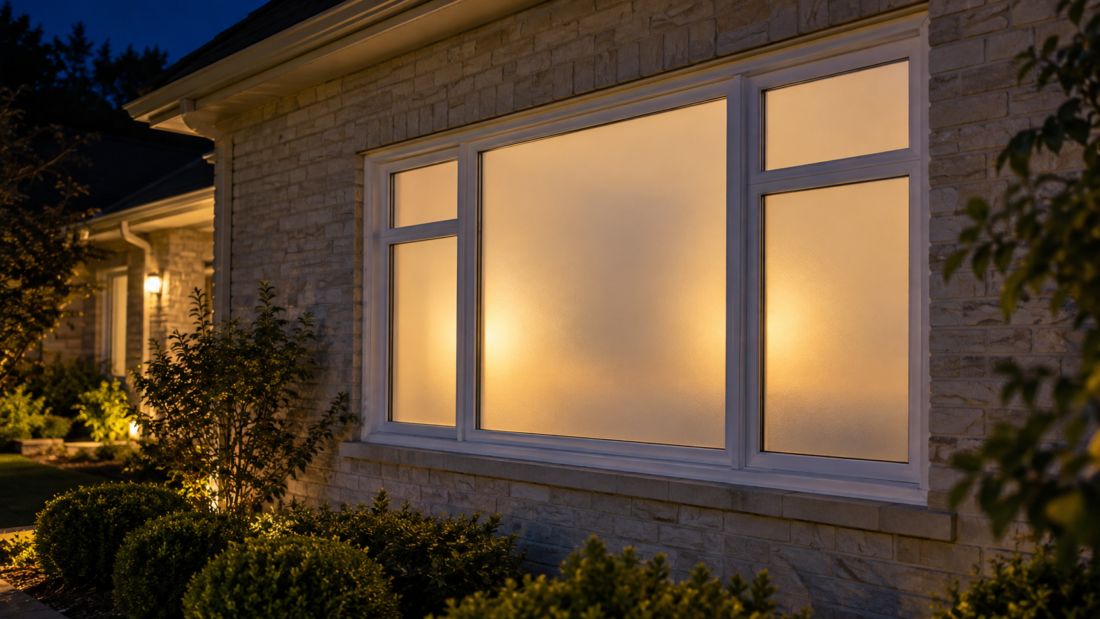
The best window film for nighttime privacy depends on the room, since a bedroom, a home office used for evening calls, and a lit storefront after closing don’t all face the same privacy problem. If you’ve already installed film and it doesn’t seem to be working after dark the way it did during the day, that’s not unusual, and it’s worth understanding why before deciding what to do next.
A lot of film marketed simply as “privacy film” is one-way reflective film, which depends on the outside being brighter than the inside to work. That condition holds during the day and flips at night, which is exactly why some readers end up here after already buying something that isn’t doing the job. This guide covers why that happens, what actually works for different rooms and applications, and how to fix it if you’re already dealing with film that’s underperforming after dark.
Key Takeaways
- Nighttime privacy is a genuinely different problem than daytime privacy, and the film that solves one doesn’t automatically solve the other.
- One-way reflective film, the most commonly marketed “privacy film,” depends on outdoor light being brighter than indoor light, which reverses at night.
- The right choice varies by room: bedrooms and bathrooms, home offices used in the evening, street-facing windows, and commercial storefronts each have slightly different priorities.
- If you already have a film that isn’t working at night, you don’t necessarily need to replace it. Adding blinds or curtains for evening hours is often a faster, cheaper fix.
- Frosted, patterned, and blackout film all perform consistently regardless of the time of day, unlike one-way reflective film.
The Short Answer
The best window film for nighttime privacy depends on the specific room. Still, frosted, patterned, and blackout film all outperform one-way reflective film after dark, since their privacy effect doesn’t depend on which side of the glass is brighter.
One-way film works well during the day but loses much of its effect at night, which is the most common reason people end up disappointed with a “privacy film” purchase.
Why Your Current Film Might Not Be Working at Night
If you installed film expecting all-day, all-night privacy and it’s not holding up after dark, you likely have one-way reflective film. This is the mirrored-looking film most people picture first when they think of “privacy film,” and it’s designed around a specific lighting condition that only exists part of the time. During the day, it does exactly what it’s supposed to. At night, with your lights on and the outside dark, that same film can let through much more visibility than you’d expect based on its daylight performance.
This isn’t a sign the film is defective. It’s simply how that particular film type is designed to work, and it’s worth knowing before deciding whether to replace it or work around it.
The Light Differential Problem
One-way film relies on a reflective coating that makes the brighter side of the glass hard to see through from the dimmer side. During the day, outdoor light is almost always brighter than indoor light, so the effect favors privacy for whoever’s inside. At night, a lit room viewed from a dark street flips that relationship entirely.
Window Film Magazine has covered this lighting-dependent behavior as one of the most common sources of buyer confusion in the privacy film category, since the product’s marketing often doesn’t make the day/night distinction clear at the point of purchase. Frosted, patterned, and blackout film don’t have this issue, since they diffuse or block light rather than relying on a brightness difference between the two sides of the glass.
Best Options by Room and Application Type
Bedrooms and Bathrooms
These rooms typically need privacy at all hours, not just during the day, so frosted or patterned film is a better default than one-way film. Both maintain natural light while providing consistent coverage, no matter when the room is in use.
Home Offices Used After Hours
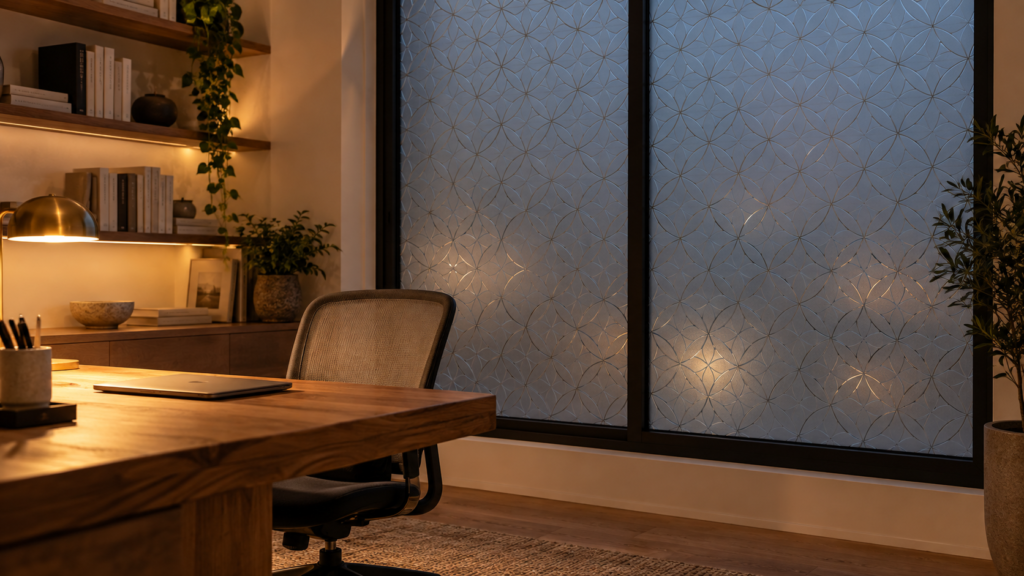
If evening video calls or after-hours work are common, a home office needs the same time-of-day consistency as a bedroom. Frosted or patterned film handles this well, and a partial frosted band at eye level can work if you don’t need a fully obscured window during the day.
Ground-Floor Windows Facing Streets or Neighbors
These windows are most likely to reveal the one-way film problem, since they’re visible from a public or semi-public space at night. Full-coverage frosted or decorative film is generally the safer choice here over one-way film, unless the space is genuinely used only during daylight hours.
Commercial Storefronts and Offices at Night
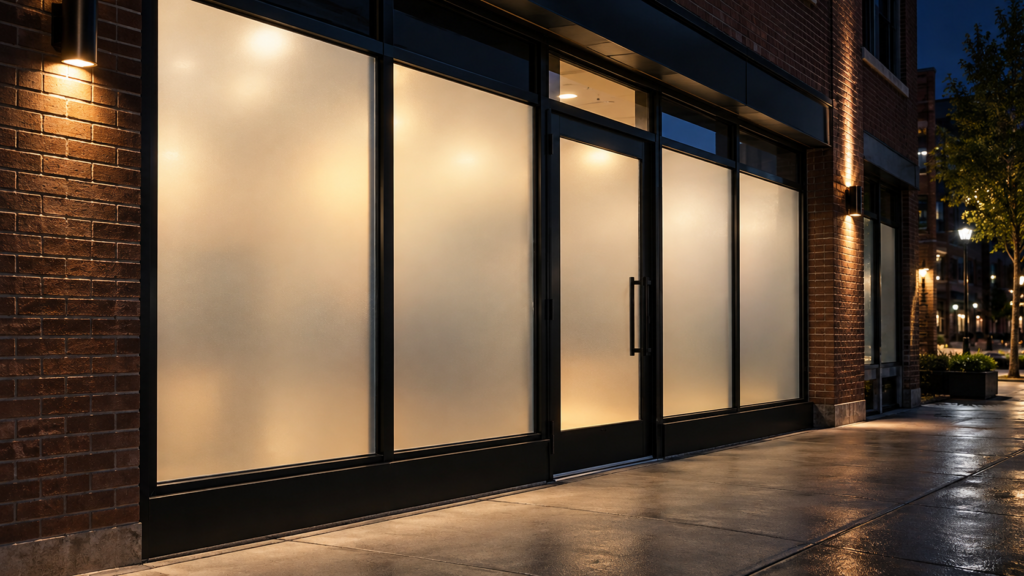
Businesses lit up after closing hours, whether for security lighting, signage, or after-hours work, face the same lighting-differential issue as a residential window, just at a larger scale. Frosted or patterned film on street-facing commercial glass avoids the after-hours visibility problem that one-way film can create once the interior lights are the dominant light source.
Comparison Table
| Film Type | Performs Consistently Day and Night | Maintains Natural Light | Best Fit |
|---|---|---|---|
| One-way reflective film | No, weakens at night | Yes | Daytime-only privacy needs |
| Frosted film | Yes | Yes | Bedrooms, offices, most residential and commercial windows |
| Patterned/decorative film | Yes | Yes | Design-conscious spaces needing consistent privacy |
| Blackout film | Yes | No, blocks most light | Maximum privacy priority over natural light |
How to Verify Film Type Before You Buy
Since the visual difference between one-way and frosted film isn’t always obvious in a product photo, confirm the film type before buying rather than assuming based on marketing language like “privacy film,” which is applied loosely to multiple products. Ask the seller directly whether the film is reflective, frosted, or patterned, and if buying online, look for product descriptions that specifically mention light diffusion versus reflection. A film described as “mirrored” or “one-way” is reflective, while “frosted,” “etched,” or “matte” descriptions point to the more consistent, day-and-night option.
Quick Fixes If You Already Have the Wrong Film
Replacing installed film isn’t always necessary. Adding blinds or curtains for evening hours is usually the fastest and least expensive way to address a one-way film’s nighttime weakness without removing anything. For a more permanent fix, remove the existing one-way film and replace it with frosted or patterned film to solve the problem at the source rather than adding a second layer of coverage. Which approach makes more sense depends on your budget, how urgently you need to solve the issue, and whether you’re satisfied with the film’s daytime performance and just need an evening solution.
Conclusion
The best window film for nighttime privacy isn’t a single product; it’s whichever option holds up consistently in your specific room, day and night. One-way reflective film is the most commonly marketed option, but it’s specifically the wrong tool for this need unless daytime privacy is genuinely your only concern. Frosted, patterned, and blackout film all avoid that limitation, and if you’re already dealing with underperforming film, a curtain or blind for evening hours is often a simpler fix than starting over.
Frequently Asked Questions
Should I avoid one-way film entirely if nighttime privacy matters to me?
You don’t necessarily have to avoid it outright, but don’t rely on it alone. If nighttime coverage is a real priority, pair it with blinds or curtains, or choose frosted or patterned film instead.
Why does my privacy film work fine during the day but not at night?
This is almost always a sign of one-way reflective film, which depends on the outside being brighter than the inside. After dark, that condition reverses, weakening the privacy effect.
Do I need to replace my current film, or can I just add curtains?
Adding blinds or curtains for evening hours is often the faster, cheaper fix if you’re otherwise happy with your film’s daytime performance. Replacing the film addresses the issue permanently but costs more.
Is frosted film a good fit for a commercial storefront?
Yes, frosted or patterned film avoids the after-hours visibility issue one-way film can create on lit storefronts, making it a more reliable choice for round-the-clock privacy.
How much does it cost to switch from one-way film to frosted film?
Cost depends on the number of windows and the specific film chosen. Still, it generally involves removing the existing film and applying new film, similar in scope to a standard film installation project.
Does the room’s usual lighting affect the right film choice?
Yes. Brightly lit rooms in the evening, like a home office or storefront, are more exposed to the light-differential problem than rooms that are rarely used or lit at night.
Can I use one-way film for daytime privacy and add something else for night?
Yes, this is a reasonable approach if daytime visibility control matters, and you’re willing to add blinds or curtains specifically for evening coverage.
Can I tell if a window already has one-way film just by looking at it during the day?
Not always. One-way film can look similar to other tints from the outside during daylight, which is part of why the nighttime performance gap catches people off guard.
Does the direction a window faces affect which film performs better at night?
Not significantly for the light-differential issue itself, since that depends on interior versus exterior lighting rather than compass direction, though window orientation can affect daytime glare and heat considerations separately.
Is there a film that performs even better than frosted film for nighttime privacy?
Blackout film provides the highest level of privacy regardless of time of day, but it sacrifices natural light for that consistency, making it a trade-off rather than a strictly better option.
Not Sure Which Film Fits Your Space?
Whether it’s a bedroom, a home office, or a commercial storefront, the right nighttime privacy solution depends on how the space is actually used, not just which film is most commonly advertised. Contact us to talk through your specific rooms and get a recommendation that holds up after dark.